Technology
LINE CRM Is Not About Adding More Tags: A Segmentation and Automation Guide for Ecommerce Brands
Learn how ecommerce brands can use LINE CRM tags, segmentation, and automation to send smarter messages, improve retention, and reduce broadcast waste.
Many brands start LINE CRM with the same assumption: “Should we tag customers in as much detail as possible?”
The answer is almost the opposite. The real value of LINE CRM is not the number of tags you create. It is whether each tag can support a decision, a segment, a message, a retargeting flow, or a member lifecycle action.
If your LINE Official Account has hundreds of tags but nobody knows which ones to use for product launches, repurchase reminders, VIP offers, or reactivation campaigns, that is not CRM. It is a messy note-taking system. A good LINE CRM setup helps your brand answer three questions: Who is this customer? Where are they in the buying journey? What should we say next?
That is why tags and segmentation have to be designed together. According to LINE Biz-Solutions, LINE has around 21 million monthly active users in Taiwan, and brands can use LINE Official Accounts to collect interaction, membership, coupon, and product data. This makes LINE a powerful entry point for first-party data. But the entry point itself is not the outcome. Data becomes valuable only when it is organized into actionable segments.
What Is LINE CRM?
LINE CRM is the practice of combining LINE Official Account interactions, member data, clicks, purchases, campaign participation, chat tags, and external system data to manage customer relationships.
It is not just a messaging tool. It is a way to move customers from “anonymous friends” to “identifiable, segmentable, and continuously manageable relationships.”
For ecommerce brands, LINE CRM usually includes four parts: collecting customer data, creating tag rules, sending messages based on segments, and using performance data to improve those tags over time.
In other words, the point of LINE CRM is not “how many people can we broadcast to?” The point is “can we send this only to the people who should actually receive it?”
Why Broadcast Messaging Is Losing Effectiveness
The biggest problem with broadcast messaging is not just wasted message cost. It teaches customers to ignore you.
When everyone receives the same discount, the same product launch, and the same countdown reminder, customers quickly start treating brand messages as background noise.
This is especially important because LINE Official Account pricing is tied to message volume. As brands grow their friend base, careless broadcasting becomes more expensive and less efficient. Segmentation is not an advanced tactic. It is cost control.
The TAGS Segmentation Framework
To keep tags from becoming chaotic, ecommerce teams can use the TAGS framework:
Trace, Attribute, Group, Send.
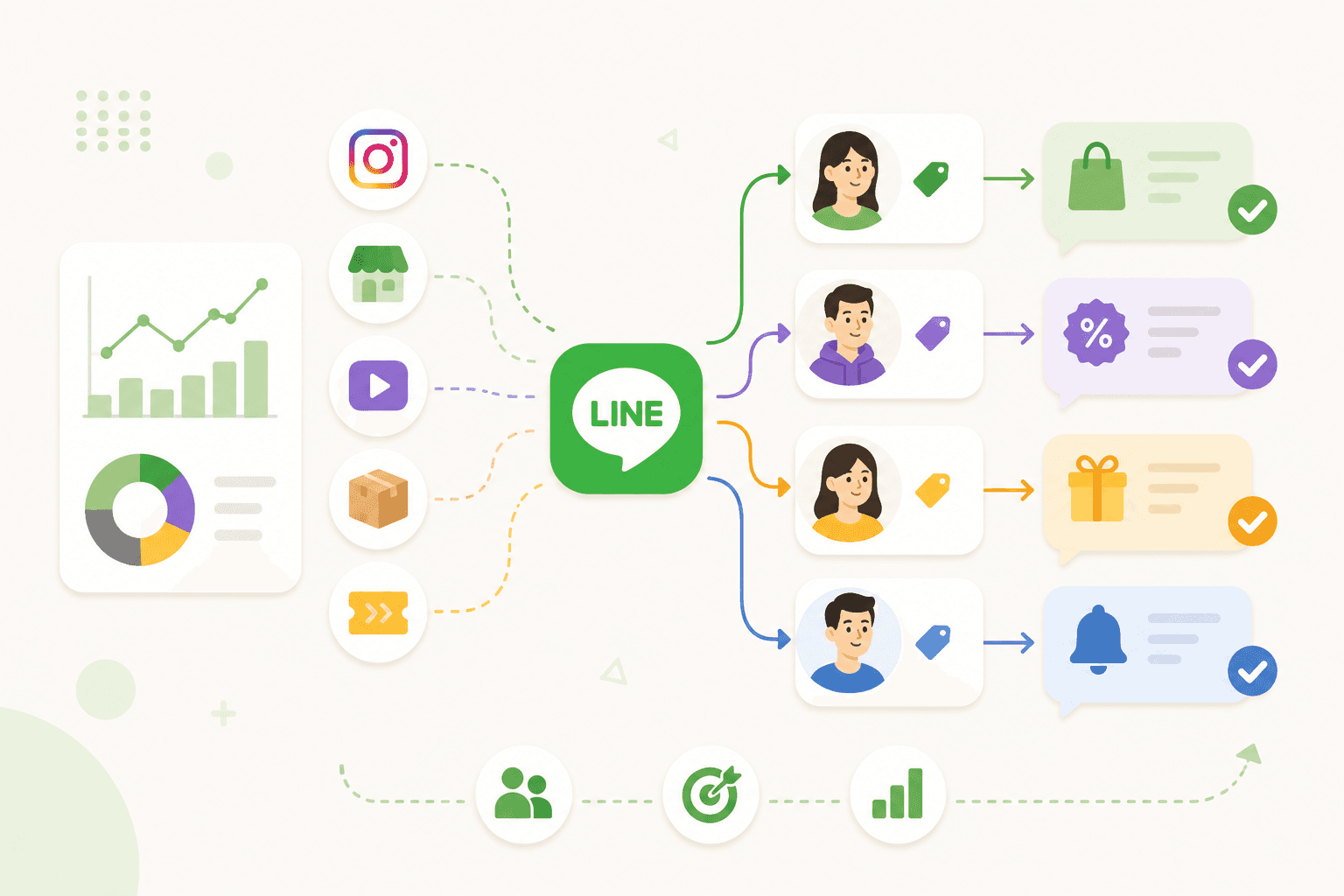
Trace means tracking where the customer came from. Source tags are often underestimated, but they are the foundation of channel analysis. A customer from Instagram ads, an in-store QR code, a livestream, a package insert, or a collaboration campaign should not be treated the same way.
Attribute means tagging preferences and customer status. This can include product interests, price sensitivity, member tier, location, purchase frequency, and recent interaction. These tags should always connect to a possible next action.
Group means combining tags into usable segments. A single tag is rarely enough. The real value comes from crossed conditions, such as “clicked product page in the last 30 days + purchased the same category before + not yet VIP.”
Send means deciding the message, timing, and frequency based on that segment. Segmentation only matters if it changes what the customer receives.
6 LINE Tag Types Ecommerce Brands Should Build First
The first type is source tags. Every friend should have a source whenever possible: ads, store, event, website, package card, social link, or referral.
The second type is product interest tags. These should come from clicks, browsing, surveys, games, or purchase behavior rather than guesswork.
The third type is buying-stage tags: new friend, browsed but not purchased, first purchase, repeat purchase, high-frequency repurchase, or dormant member.
The fourth type is customer value tags. Do not only tag VIPs. Also track high-margin category buyers, frequent discount users, customers close to a free-shipping threshold, and high-return-risk customers.
The fifth type is engagement-strength tags. Recent clicks, 30-day inactivity, campaign participation, survey completion, or rich menu clicks all indicate different communication temperatures.
The sixth type is consent and compliance tags. This is often ignored, but it protects the brand. If you use phone numbers, emails, UID data, website traffic, or LINE Tag data for audiences and retargeting, you need to manage data source, purpose, and consent status clearly.
How to Design Segmented LINE Messages
A simple way to design every LINE push message is to answer four questions:
Who is this for?
Why do they need it now?
What should we say?
Which metric will tell us whether it worked?
For example, a skincare brand might create a segment of “clicked anti-aging products + no purchase in 60 days + previously bought serum.” That audience does not need a generic storewide discount. They need content about the missing step in their skincare routine, paired with a relevant bundle offer.
A fashion brand might create a segment of “from Instagram ads + clicked dresses + no first purchase.” That group may need styling context and a first-purchase incentive, not another generic campaign blast.
LINE CRM should not only run promotions. It should connect content, membership, products, and service into a customer journey.
Retargeting and Audience Sharing Considerations
LINE Business Manager supports multiple audience sources, including website traffic, impressions, clicks, chat tags, friend paths, uploaded phone numbers, and email data. Some audiences also have minimum-size requirements before they can be shared or used for messaging.
This gives ecommerce brands two reminders.
First, not every tag should be used for ads or retargeting. Some audiences may be too small, and some messages may be too sensitive.
Second, data movement needs governance. Brands should clearly explain how data is collected and used, and they need a lawful basis for marketing use.
Under Taiwan’s Personal Data Protection Act, personal data should generally be used within the necessary scope of the original collection purpose. If a person refuses marketing use, the organization should stop using that data for marketing.
So LINE CRM maturity is not only about automation. It is also about whether your brand can answer: Where did this data come from? Was the customer informed? Can they opt out?
A Practical LINE CRM Starting Plan
In week one, audit your existing tags. Remove tags that nobody uses, tags with duplicate meanings, and tags that do not connect to any marketing action.
In week two, create three core segments: new friends without first purchase, purchased customers ready for repurchase, and high-engagement non-buyers.
In week three, design one message path for each segment. New friends need education and trust. Existing buyers need usage tips and replenishment reminders. High-engagement non-buyers need comparison content, proof, or a time-sensitive reason to buy.
In week four, review the data. Do not only ask, “Did this message sell?” Ask, “Which tag combinations should we keep, split, merge, or retire?”
Conclusion
LINE CRM is not about turning your Official Account into a louder broadcasting channel. It is about turning every interaction into data for the next decision.
Tags are not better because there are more of them. Segments are not better because they are narrower. Automation is not better because it is more complex.
The best LINE CRM system is one where every tag helps decide the right audience, message, offer, timing, and next step.
For ecommerce brands, LINE is a powerful customer entry point. But the real advantage starts when you use the TAGS framework to connect source, attributes, segments, and messaging into a repeatable member growth system.
FAQ
What is LINE CRM?
LINE CRM is the practice of combining LINE Official Account friend data, member data, interactions, clicks, purchases, and tags to support segmented messaging, member management, retargeting, and customer relationship management.
What is the difference between LINE tags and segments?
A tag describes one customer attribute or behavior. A segment combines multiple tags or conditions into an audience that can be used for messaging or marketing decisions.
Which LINE tags should ecommerce brands create first?
Start with six types: source, product interest, buying stage, customer value, engagement strength, and consent status. These are the easiest to connect directly to messaging, offers, membership, and retargeting.
Does LINE CRM always require API integration?
No. Smaller brands can begin with LINE Official Account features such as chat tags, rich menus, coupons, surveys, and member binding. API integration becomes more useful when tagging rules, data volume, and automation logic become more complex.
Can segmented audiences become too small?
Yes. Segmentation is not about making audiences as narrow as possible. Start with operationally useful groups such as new friends, first-time buyers, repeat buyers, and dormant members, then add product interest, source, and engagement conditions gradually.
Related articles
Our platform is designed to empower businesses of all sizes to work smarter and achieve their goals with confidence.
When researching Shopify Taiwan case studies, brand owners should look beyond design, apps, and checkout. This guide explains how Taiwan ecommerce brands can turn Shopify traffic into LINE friends, customer intent signals, and repeat engagement.

LINE chatbot can't answer cross-channel questions? It's not a vendor problem — it's a data boundary. Use Ezily's Visibility Layers framework to diagnose.
LINE Mini App is changing how Taiwan e-commerce brands interact with customers. This article breaks down five major shifts, three key opportunities, and how Ezily Touchpoints helps brands launch LINE Mini App experiences faster.